
|
||||||
|
||||||
|
||||||
|
||||||
|
||||||
|
||||||
|
||||||
|
||||||






Scambaiting
Scambaiter:
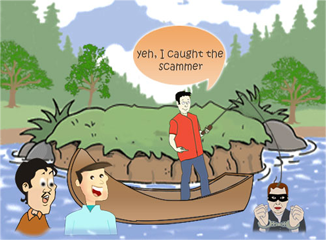
- Scambaiting in simple words, is wasting the precious time of a spammer pretending that you are interested in their schemes.
- It is a method of entertaining the baiter and pretending as if you are ready to perform some ludicrous tasks. Thus indirectly you are keeping the scammers from potential victims who may fall in trap with the scammers.
- Scambaiting is the practice of pretending interest in a fraudulent scheme in order to influence a scammer in many possible ways. Scam baiting emerged in response to e-mail based frauds such as the common Nigerian 419 scam.
- It may also be considered as a type of sting operation, although many scam baits are simply to waste time instead of catching the scammers.
Scambaiter's Task:
- Send the scam mail senders to a Western Union office to collect the supposedly sent money and get them to book hotels for them.
- A few scam baiters have also succeeded in receiving cash from the fraudsters.
- Giving the scam a long, silly questionnaire to fill out filling up their inboxes with large attachments making Nigerian scam mailers call the baiters back on the telephone (using anonymous VOIP numbers), in order to waste their time and money hacking into the scammers email accounts in order to find their victims addresses which can be passed on to legal authorities in the hope that they will be prosecuted, or simply to amuse the baiter.
Scambaiter's Goal:

Several websites publish transcripts of correspondences between baiters and scammers. One common goal of scam baiting has become the photographic trophy. The scam mail senders, sometimes known as lads, are goaded or cajoled by the Mugus, or victims, into having a picture taken by them.
Principles of Scambaiting:
Baiting the scammers:
which can be passed on to legal authorities in the hope that they will be prosecuted, or simply to amuse the baiter.
- To waste the scammers' time
- To embarrass the scammers
- Cause the scammers to reveal confidential information
which can be passed on to legal authorities in the hope that they will be prosecuted, or simply to amuse the baiter.
ASEM bait:
- A new technique called an "ASEM bait" (Accidentally Sent E-Mail) has been recently developed. It fools the scammer into believing that the scam baiter has accidentally sent an e-mail to him when the "victim" is actually intending to send the e-mail to another fraudster.
- Many ASEM baits have been very successful. A beneficial side-effect of scambaiting has been the exposure of false and fraudulent "banking" and "credit" services, which are often created by the scammers to further their scams and make them seem legitimate.
- Scam-baiting is a potentially dangerous activity. At least one scam victim has been murdered as the result of a Nigerian 419 scam, and scam-baiters are presumably not well-liked by the 419 scam operators.
General Scambaiting tips:
- Before you start to scambait, make sure you readily have doctored details of your name, address, phone, etc. that helps you prevent from getting doubted by the scammers.
- Have separate email account in either one of this commonly used email settings -Gmail, yahoo, hotmail, live.com, etc.
- Ensure to give only the ostensible information that remains far from truth or of complete fake details.
- As there are chances to have your IP address get traced, it is better to use a fake address of the nearby city.
- It is recommended not to give any phone number details to scammers; the situation can be managed by sending messages online instead revealing any phone numbers.
- Remember to use a fake name in the ID. In order to avoid commotions from other real users, you can use certain names that are more recognized as fake by any westerner.
- Use Orbitz or Travelocity for giving any flight details to the scammers.

Nigerianspam.com is dedicated to all the hardworking people who have been scammed by the spammer or 419 scam frauds. Although our site concentrates on providing awareness of Nigerian 419 spam (scam), scam baiting, advance fee fraud, scam phising, also we deal with other types of fraud such as letter spam, e-mail scam, lottery spam as well. You can go through our scam baiting tips, it is just amazing way to deal with the spammer or scammer.
Nigerian Scam | 419 Scam | Features of Scam | Mission | Research | Mail Archives | About Us | File A Complaint | Spam News | Origin Of Scam | Operation Of Scam | Consequences | Miscellaneous Scams | Scam Sites | FAQ | Contact Us | Scam Resources Links | Nigerian Scammers | Site Map | Mail Archives SiteMap | Scam Glossary | Scam Resources Books | Scam Checker Tool | Scam baiting | More Scam Sites | Scam Awareness Quiz | Celebrity Scam | Search Engine Genie | Bharat Udyog Ratna Award Scam Alert | Jeff Adams Real Estate Seminar | Russ Whitney Real Estate