
|
||||||
|
||||||
|
||||||
|
||||||
|
||||||
|
||||||
|
||||||
|
||||||




Origin of "Scam"

The word "scam" is a quite new addition to the modern English language. Its genesis is not completely clear, but researchers have traced its first recorded and use in a publication to an article that came in TIME magazine (1963).
419 scam origin is debated. Several critics believe that the scam first was introduced to Nigeria by Nigerian petroleum companies and some criminal gangs in 1970s or 1980s. There are others who assume that the scam was a combination of different frauds in the Igboland region, some hundreds of years old.
419 scam origin is debated. Several critics believe that the scam first was introduced to Nigeria by Nigerian petroleum companies and some criminal gangs in 1970s or 1980s. There are others who assume that the scam was a combination of different frauds in the Igboland region, some hundreds of years old.
Scammers-location:
The first"scam"involved profitable oil contracts and other interrelated frauds. Until about 2001, the scammers were to be found primarily in Aba, Owerri, Lagos, Port Harcourt and Nigeria. The scammers have lately set up their base in many countries moreover Nigeria, including Togo, the Ivory Coast, the Netherlands, the United Kingdom, and Canada.
Nigerian money transfer fraud is the other name for Nigerian scam or 419 scam. They are associated in the public mind with Nigeria due to the increase of such confidence tricks from Nigeria since the mid-eighties, although they are often carried out in other African nations, and increasingly from European cities with large Nigerian populations, notably London and Amsterdam.
Scammers-goal:
The goal of the scammers is to cheat the victim into thinking that he or she has been singled out to contribute in a very profitable although questionable -- arrangement. The intended victim is at peace of the authenticity of the arrangement by fake or false documents bearing apparently official Nigerian government letterhead, seals, as well as phony letters of credit, payment schedules and bank drafts. The scammer may even found the credibility of his contacts, and thereby his influence, by arranging a meeting between the victim and "government officials" in real or counterfeit government offices.
Once the victim becomes sure of the probable success of the deal, something goes wrong. The victim is then forced or threatened to provide one or more large sums of money to save the project. For example, an official will order an up-front bribe or an unanticipated tax or fee to the Nigerian government will have to be paid before the money can be transferred. Each fee paid is explained as the very last fee required. The plan may be stretched out over many months.
Once the victim becomes sure of the probable success of the deal, something goes wrong. The victim is then forced or threatened to provide one or more large sums of money to save the project. For example, an official will order an up-front bribe or an unanticipated tax or fee to the Nigerian government will have to be paid before the money can be transferred. Each fee paid is explained as the very last fee required. The plan may be stretched out over many months.
Top 10 Types of scams:
-
Advance charge loans
-
Big Business opportunities
-
False Checks
-
Internet: Common Commodities
-
Internet: Auctions
-
Lotteries
-
Nigerian Funds Offers
-
Prize/free gifts
-
Phishing
-
Sweetheart Swindles
Password Scams:
At first the scammers obtain account addresses. Then they use computer scripts to make passwords using words commonly found in the dictionary and work with that passwords in the hope of finding one that lets them in. When a password (working) is found, they go about the nefarious business of grabbing your contacts from the host service and sending out the kind of messages that your contacts received. Depending on the kinds of service, they can also forward messages to a different account.
There are different strategies for creating and recollecting passwords. People often substitute characters for letters @ for A, ! for L and $ for S etc. To overcome this, choose the password field, click and hold on the 1Password button that appears in your browser, and select Strong Password Generator.
There are different strategies for creating and recollecting passwords. People often substitute characters for letters @ for A, ! for L and $ for S etc. To overcome this, choose the password field, click and hold on the 1Password button that appears in your browser, and select Strong Password Generator.
Reporting Scams:
Originally, the scammers contacted heads of companies and church officials; however, the use of scam email and instant messaging for the initial contacts has led to many private citizens also being targeted, as the cost to the scammers to make initial contact was much lower.
The process of reporting scams is actually quite simple. There are several government and independent organizations devoted to putting a stop to internet scams. They depend on people reporting scams in order to fight internet scammers.
If an email is received which proposes a business proposition from Nigeria or Wealthy Nigerian royalty in need of temporary cash, this is called a 419 scam. Start reporting fraud and scams pertinent to the 419 scams by contacting Fraudaid.com.
The United States Federal Trade Commission has issued a Consumer Alert (http://www.ftc.gov/bcp/conline/pubs/alerts/nigeralrt.htm) about the Nigerian spam(scam). It states: "If you receive an offer via nigerian mail (email) from someone claiming to need your help getting money out of Nigeria - or any other country, for that matter - forward it to the FTC at spam@uce.gov.
The process of reporting scams is actually quite simple. There are several government and independent organizations devoted to putting a stop to internet scams. They depend on people reporting scams in order to fight internet scammers.
If an email is received which proposes a business proposition from Nigeria or Wealthy Nigerian royalty in need of temporary cash, this is called a 419 scam. Start reporting fraud and scams pertinent to the 419 scams by contacting Fraudaid.com.
The United States Federal Trade Commission has issued a Consumer Alert (http://www.ftc.gov/bcp/conline/pubs/alerts/nigeralrt.htm) about the Nigerian spam(scam). It states: "If you receive an offer via nigerian mail (email) from someone claiming to need your help getting money out of Nigeria - or any other country, for that matter - forward it to the FTC at spam@uce.gov.
Books related to scams:
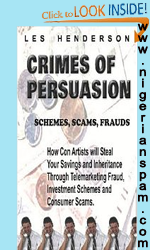
Author:Les Henderson
Publication date: 2003-05-13
Release Date: 2003-05-17
Title:Schemes, Scams, Frauds
Description:The crimes of persuasion tells about how can Artists will steal your savings and inheritance through telemarketing fraud,Investment schemes and consumer scames.It effectively be taken to minimize the impact on its victims and ensure that adequate penalties are in place to deter the perpetrators.
Publication date: 2003-05-13
Release Date: 2003-05-17
Title:Schemes, Scams, Frauds
Description:The crimes of persuasion tells about how can Artists will steal your savings and inheritance through telemarketing fraud,Investment schemes and consumer scames.It effectively be taken to minimize the impact on its victims and ensure that adequate penalties are in place to deter the perpetrators.
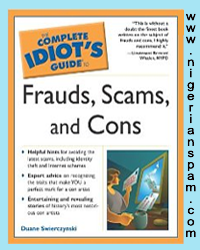
Author:Duane Swierczynski
Publication Date:ecember 17, 2002 by Alpha
Release Date:January 30,2003
Title:Frauds,Scams,Cons
Description:It hepls to avoid latest scams including identity theft and internet schemes and up-to-date advice on how you can protect yourself from unscrupulous cons of every conceivable stripe.It can be updated yearly, if necessary, to expose all the latest schemes.
Publication Date:ecember 17, 2002 by Alpha
Release Date:January 30,2003
Title:Frauds,Scams,Cons
Description:It hepls to avoid latest scams including identity theft and internet schemes and up-to-date advice on how you can protect yourself from unscrupulous cons of every conceivable stripe.It can be updated yearly, if necessary, to expose all the latest schemes.
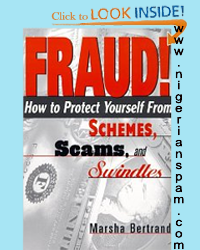
Author:Marsha Bertrand
Publication Date:December 10,2009
Title:Scams,swindle,scams
Description:It describes how to protect yourself from schemes, scams and swindles.Phishing, Spoofing, ID Theft, Nigerian Advance Schemes Investment Frauds: How to Recognize And Avoid Rip-Offs In The Internet Age
Publication Date:December 10,2009
Title:Scams,swindle,scams
Description:It describes how to protect yourself from schemes, scams and swindles.Phishing, Spoofing, ID Theft, Nigerian Advance Schemes Investment Frauds: How to Recognize And Avoid Rip-Offs In The Internet Age
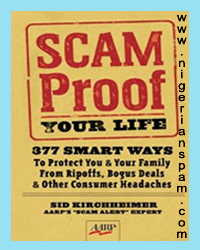
Author:Sid Kirchheimer
Publication Date:Febrauary 2007
Title:Scam proofs,Ripoffs
Description:Smart Ways to Protect You & Your Family from Ripoffs, Bogus Deals & Other Consumer Headaches and your healthcare bills to shielding yourself from the growing number of international financial scams, this book is not just a reference: it's an education!
Publication Date:Febrauary 2007
Title:Scam proofs,Ripoffs
Description:Smart Ways to Protect You & Your Family from Ripoffs, Bogus Deals & Other Consumer Headaches and your healthcare bills to shielding yourself from the growing number of international financial scams, this book is not just a reference: it's an education!
Nigerianspam.com is dedicated to all the hardworking people who have been scammed by the spammer or 419 scam frauds. Although our site concentrates on providing awareness of Nigerian 419 spam (scam), scam baiting, advance fee fraud, scam phising, also we deal with other types of fraud such as letter spam, e-mail scam, lottery spam as well. You can go through our scam baiting tips, it is just amazing way to deal with the spammer or scammer.
Nigerian Scam | 419 Scam | Features of Scam | Mission | Research | Mail Archives | About Us | File A Complaint | Spam News | Origin Of Scam | Operation Of Scam | Consequences | Miscellaneous Scams | Scam Sites | FAQ | Contact Us | Scam Resources Links | Nigerian Scammers | Site Map | Mail Archives SiteMap | Scam Glossary | Scam Resources Books | Scam Checker Tool | Scam baiting | More Scam Sites | Scam Awareness Quiz | Celebrity Scam | Search Engine Genie | Bharat Udyog Ratna Award Scam Alert | Jeff Adams Real Estate Seminar | Russ Whitney Real Estate