
|
||||||
|
||||||
|
||||||
|
||||||
|
||||||
|
||||||
|
||||||
|
||||||





Nigerian Scam Mission
The process of spamming happens in
a tricky and hidden manner. There would be a touch of secrecy
and speculation in the way mails reach you. Spammers know
all the possible ways to trap a person and they are qualified
enough in sending you reality mails in a way that there
are no loopholes left. Spam mails will not let open any
chances that raise your doubt over the matter.
When such tricky ways are employed to entrap you, it is your diligence and intelligence that should keep your intentions away from taking the wrong step. But awareness about spamming and its various problems and troubles will help you avoid such tribulations in the future.
When such tricky ways are employed to entrap you, it is your diligence and intelligence that should keep your intentions away from taking the wrong step. But awareness about spamming and its various problems and troubles will help you avoid such tribulations in the future.
Our Mission
Our mission is to educate
and alert users from unwanted and unsolicited mails and
protect them from unnecessary problems. We teach you the
other side of the “fortune” the spam mails promise.
Once you consider the mail these spammers send you, you are making yourself ready to lose your money and property slowly and unknowingly giving away your possessions to people whom you have never met. The irony of the statement is expressed in itself. You are taking a chance to get more and you become the loser. In simple words, to get more you lose everything.
Once you consider the mail these spammers send you, you are making yourself ready to lose your money and property slowly and unknowingly giving away your possessions to people whom you have never met. The irony of the statement is expressed in itself. You are taking a chance to get more and you become the loser. In simple words, to get more you lose everything.
Solutions To Scam419
We prepare you to avert problems
that may happen because of spam mails. As a net savvy you
might be in a risk of getting spam mails and you might fall
in the trap.
Telemarketing Scam
When you send money to people you do not know
personally or give personal or financial information to unidentified
callers, you increase your prospect of becoming a victim of telemarketing fraud.
Warning signs -- what a caller might tell you:
- "You must act 'now' or the offer won't be good."
- "You've won a 'free' gift, holiday, or prize." But you have to give for "postage and handling" or other charges.
- "You must send money, give a credit card or bank account details, or have a check picked up by courier." You may hear this before you have had a chance to consider the offer cautiously.
- "You don't need to ensure out the company with anyone." The callers say you do not need to speak to anyone including your relations, lawyer, accountant, local Better Business Bureau, or consumer defense agency.
- "You don't need any written information about their company or their references."
- "You can't afford to miss this 'high-profit, no-risk' offer."
If you hear these--or similar lines" from a telephone salesperson, just say "no thank you," and droop the phone.
Some Tips to keep away from Telemarketing Scam:

- It's very difficult to get your money back if you've been scammed over the phone. Before you buy anything by telephone, remember.
- Don't buy from a strange company. Genuine businesses understand that you want more information about their company and are happy to comply.
- Always ask for and wait until you receive written objects about any offer or aid. If you get unsolicited mail about costly investments, ask someone whose financial advice you trust to review them. But, unfortunately, be careful not everything written down is true.
- You must not be asked to pay in advance for services. Pay services only after they are send.
Nigerian Letter or "419" Scam Letter
Nigerian letter frauds bond the threat of impression
fraud with a variation of an advance fee scheme in which a letter, mailed from Nigeria,
offers the receiver the "chance" to share in a percentage of millions of dollars that the
author, a self-proclaimed government official, is trying to transfer illicitly out of Nigeria.
The beneficiary is encouraged to send information to the author, such as blank letterhead
stationery, bank name and account numbers and other identifying information using a duplicate
number provided in the letter. Some of these letters have also been received via E-mail through
the Internet. The scheme relies on convincing a willing victim, who has demonstrated a "propensity
for larceny" by responding to the request, to send money to the author of the letter in Nigeria in
several installments of increasing amounts for a diversity of reasons.
Payment of taxes, bribes to government officials, and legal fees are often described in great detail with the assure that all expenses will be refunded as soon as the funds are spirited out of Nigeria. In reality, the millions of dollars do not exist and the victim eventually ends up with nothing but loss.
Payment of taxes, bribes to government officials, and legal fees are often described in great detail with the assure that all expenses will be refunded as soon as the funds are spirited out of Nigeria. In reality, the millions of dollars do not exist and the victim eventually ends up with nothing but loss.
Some Tips to Avoid Nigerian Letter or "419" Scam Letter
- If you get a letter from Nigeria asking you to send personal or banking details, do not respond in any manner. Send the letter to the U.S. Secret Service, your local FBI office, or the U.S. Postal Inspection Service.
- If you identify someone who is corresponding in one of these schemes, support that person to contact the FBI or the U.S. Secret Service quickly.
- Be mocking of folks representing themselves as Nigerian or foreign government officials asking for your help in placing large sums of money in overseas bank accounts.
- Do not judge the promise of large sums of money for your cooperation. keep your account information safety.
Impersonation/Identity Scam
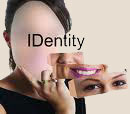
Impersonation fraud happens when someone assumes
your identity to execute a fraud or other criminal act. Criminals can
get the information they need to assume your identity from a range of sources,
such as the theft of your wallet, your junk email, or from credit card or
bank information. They may contact you in person, by telephone, or on the
Internet and ask you for the information.The sources of information about you
are so frequent that you cannot prevent the theft of your identity. But you
can minimize your risk of loss by following a few simple hints.
Some Tips to Avoid Impersonation/Identity Scam
- Never throw away ATM receipts, credit statements, credit cards, or bank statements in a working form.
- Do not give your credit card number over the telephone unless you make the call.
- Settle your bank account monthly and notify your bank of discrepancies instantly.
- Keep a list of telephone numbers to call to compliant the loss or theft of your wallet, credit cards, etc.
- Report unauthorized financial transactions to your bank, credit card Company, and the police as soon as you notice them.
- Review a copy of your credit report at least once each year. Notify the credit agency in writing of any questionable entries and follow through until they are explained or removed.
Advance Fee Scheme
An advance fee scheme happen when the victim pays money
to someone in anticipation of receiving something of greater value, such as
a loan, contract, investment, or gift, and then receives little or nothing
in return.
Some Tips to Avoid the Advanced Fee Schemes
- If the offer of an "opportunity" emerges too good to be true, it maybe is. Follow ordinary business practice. For example, legitimate business is seldom conducted in cash on a street bend.
- Know who you are dealing with. If you have not heard of a person or business that you intend to do business with, learn more about them. Depending on the amount of money that you intend to use, you may want to visit the business location, check with the Better Business Bureau, or consult with your bank, a lawyer, or the police.
- Make sure you fully understand any business agreement that you enter into. If the terms are composite, have them reviewed by a capable lawyer.
- Be wary of businesses that function out of post office boxes or mail drops and do not have a street address, or of dealing with persons who do not have a straight telephone line, who are never "in" when you call, but always return your call later.
Our mission gives the right vision for you to be ready to
"just avoid" scam419 what you are not supposed to accept.
Books Related To Nigerian Scam Mission
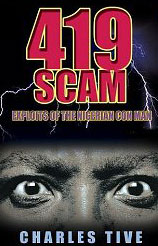
Title:419 Scam: Exploits of the Nigerian Con Man
Author:Charles Tive
Tags:Scam419, Avoiding Scams, Emails
Release Date: September 27, 2006
Description: The most recurrent type of transnational "419" scam is the "advance fee fraud". It is usually introduced in the form of a business contract, a transfer of stolen money or money from over-invoiced contract, the purchase of crude oil from Nigeria at a relatively cheap rate, and transfer of money left by a deceased person (will scam).
Author:Charles Tive
Tags:Scam419, Avoiding Scams, Emails
Release Date: September 27, 2006
Description: The most recurrent type of transnational "419" scam is the "advance fee fraud". It is usually introduced in the form of a business contract, a transfer of stolen money or money from over-invoiced contract, the purchase of crude oil from Nigeria at a relatively cheap rate, and transfer of money left by a deceased person (will scam).
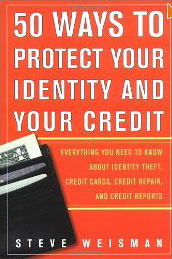
Title:50 Ways to Protect Your Identity and Your Credit: Everything You Need to
Know About Identity Theft, Credit Cards, Credit Repair, and Credit Reports
Author:Steve Weisman
Tags: Identity Theft, Credit Cards, Credit Repair, and Credit Reports
Release Date: January 2005
Description: Identity theft and bad credit-two of the most feared byproducts of the information age, and subjects about which few really understand. Weisman offers reassurance in the form of 50 steps that will guard against both of these modern perils.
Author:Steve Weisman
Tags: Identity Theft, Credit Cards, Credit Repair, and Credit Reports
Release Date: January 2005
Description: Identity theft and bad credit-two of the most feared byproducts of the information age, and subjects about which few really understand. Weisman offers reassurance in the form of 50 steps that will guard against both of these modern perils.
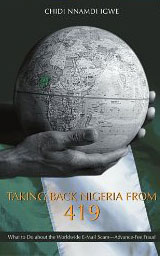
Title:Taking Back Nigeria from 419: What
to Do about the Worldwide E-Mail Scam-Advance-Fee Fraud
Author:Chidi Nnamdi Igwe
Tags: Analyzes 419 from a historical, political, and economic perspective
Release Date: August 28, 2007
Description: Concerned Nigerian native Chidi Igwe analyzes 419 from a historical, political, and economic perspective in an impassioned effort to raise public awareness about the scandal that has tainted his country.
Author:Chidi Nnamdi Igwe
Tags: Analyzes 419 from a historical, political, and economic perspective
Release Date: August 28, 2007
Description: Concerned Nigerian native Chidi Igwe analyzes 419 from a historical, political, and economic perspective in an impassioned effort to raise public awareness about the scandal that has tainted his country.
Nigerianspam.com is dedicated to all the hardworking people who have been scammed by the spammer or 419 scam frauds. Although our site concentrates on providing awareness of Nigerian 419 spam (scam), scam baiting, advance fee fraud, scam phising, also we deal with other types of fraud such as letter spam, e-mail scam, lottery spam as well. You can go through our scam baiting tips, it is just amazing way to deal with the spammer or scammer.
Nigerian Scam | 419 Scam | Features of Scam | Mission | Research | Mail Archives | About Us | File A Complaint | Spam News | Origin Of Scam | Operation Of Scam | Consequences | Miscellaneous Scams | Scam Sites | FAQ | Contact Us | Scam Resources Links | Nigerian Scammers | Site Map | Mail Archives SiteMap | Scam Glossary | Scam Resources Books | Scam Checker Tool | Scam baiting | More Scam Sites | Scam Awareness Quiz | Celebrity Scam | Search Engine Genie | Bharat Udyog Ratna Award Scam Alert | Jeff Adams Real Estate Seminar | Russ Whitney Real Estate