
|
||||||
|
||||||
|
||||||
|
||||||
|
||||||
|
||||||
|
||||||
|
||||||
|
||||||






419 Scam Frequently Asked Questions
1.What
is this 419 Scam FAQ about?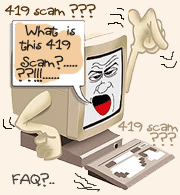
2.What are tactics used by 419 Scam senders schemes?
3.How do I know if an email is a 419 spam?
4.How does these 419 spam mailers get my name/e-mail address?
5.Do the 419 scam mailers know who I am, or any other information about me?
6.Who are the people who are sending these 419 scam messages?
7.You're kidding - you mean people actually fall for this fraud spams?
8.What are the main categories these 419 spam fraud business proposals falls?
9.Why 419 Spammer's are increasing in recent years?
10.How can I help fight and protect others from 419 scam?
11.Since when has this 419 scam been around?
12.What is a "mugu"?
2.What are tactics used by 419 Scam senders schemes?
3.How do I know if an email is a 419 spam?
4.How does these 419 spam mailers get my name/e-mail address?
5.Do the 419 scam mailers know who I am, or any other information about me?
6.Who are the people who are sending these 419 scam messages?
7.You're kidding - you mean people actually fall for this fraud spams?
8.What are the main categories these 419 spam fraud business proposals falls?
9.Why 419 Spammer's are increasing in recent years?
10.How can I help fight and protect others from 419 scam?
11.Since when has this 419 scam been around?
12.What is a "mugu"?
 What is this 419
Scam FAQ about?
What is this 419
Scam FAQ about?This collection of frequently asked questions (FAQ) answers the questions about the Advance Fee Fraud ("419 scam") (419 Scammer”). The scam is named the section of the Nigerian penal code dealing with fraud.
What are tactics used by 419
Scam senders schemes? An individual or any company receives a letter or fax from
an alleged "official" representing any foreign
government or agency.
An offer available to transfer millions of dollars in "over
invoiced contract" funds into your bank account.
You could encourage traveling overseas to complete the transaction.
You might be requested to provide blank company letterhead
forms, banking account information, and telephone and fax
numbers.
You receive many documents with official looking stamps,
seals and company logo testifying Scammers authenticity
of the proposal.
Eventually you must provide up-front or advance fees fraud
for various taxes, attorney fees, and transaction fees or
try to bribe.
Other forms of 4-1-9 schemes include: c.o.d. of goods and
services, real estate ventures, purchases of crude oil at
less prices, beneficiary of a will, and recipient of an
award or paper currency conversion.
How do I know if an email is
a 419 spam?
An individual or any company receives a letter or fax from
an alleged "official" representing any foreign
government or agency.
An offer available to transfer millions of dollars in "over
invoiced contract" funds into your bank account.
You could encourage traveling overseas to complete the transaction.
You might be requested to provide blank company letterhead
forms, banking account information, and telephone and fax
numbers.
You receive many documents with official looking stamps,
seals and company logo testifying Scammers authenticity
of the proposal.
Eventually you must provide up-front or advance fees fraud
for various taxes, attorney fees, and transaction fees or
try to bribe.
Other forms of 4-1-9 schemes include: c.o.d. of goods and
services, real estate ventures, purchases of crude oil at
less prices, beneficiary of a will, and recipient of an
award or paper currency conversion.
How do I know if an email is
a 419 spam?The general rule of thumb is, if it sounds too attractive to be true, it probably is. There is a number of what we call "red flags", markers, which show up in typical 419 scam emails, such as certain phrases or few ways of doing things. You can also learn to spot these by yourself. You can check any type of suspicious 419 scam email by posting it in the fraudwatchers.org forum where anti-fraud experts would be ready to give your their advice (look for a section called "419 Scam or Not”).
How does these 419 spam mailers
get my name/e-mail address?The key thing to understand here is that, in spite of the cool nature of this 419 fraud, the way in which it is spread is quite familiar; this is basically a more strong form of "spam", or unsolicited commercial e-mail (UCE). The messages are mass mailed in precisely the same way as the more ordinary "XXX", "Toner Supplies" and "Make Money Fast" junk e-mails, which appear in your inbox on an everyday basis. All they want is to get a 419 scam message into someone's inbox is a valid e-mail address, and they also collect it same way that other 419 spam senders do: they buy the lists collected by other spammers, they harvest addresses themselves from Usenet postings, they start to rub online directories, and sometimes they can even find a mail host and just try every possible 8-character email address for that host. There are many other possible ways for them to collect e-mail addresses, and no matter how enthusiastically you limit who give you your address to, chances are that finally it would make it onto somebody's mass mailing list.
Do the 419 scam mailers know
who I am, or any other information about me?There is very little probability that they know any of your personal information, despite the pledge that they "know you to be a person of integrity" and "discreteness". They don't know you any more than they know the millions, perhaps billions - of other people around the world that they try to trick. To them, all you are is an email address that didn't bounce.
Who are the people who are sending
these 419 scam messages?The agreement among government and the law enforcement officials around the world, with information security experts is that despite the many countries that 419 scam messages appear to be originate from, the source is, actually, in Nigeria, though Amsterdam, in the Netherlands shows to be a center of action in few recent years as well. Although the Nigerian government claims to be cracking down on them, it is usually believed that they are actually protecting these 419 scammers; in fact, many believe that Nigerian government officials are also scammers. Whether this is true or not, it has been supposed that the reason the Nigerian government allows the 419 scam to continue is that it is predictable to be the third or fourth largest source of revenue for the Nigerian economy.
You're kidding - you mean people
actually fall for this fraud spams?You bet. May be you do not know, this has been going on for more than 20 years - if go fishing is good, you don't change the bait you're using. Not only are there many existing documented cases of people who have had their fraud by bank accounts drained by 419 scam senders, there are also cases of people who have been bait into traveling to Nigeria and entering the country without any passport that puts them at the complete pity of the spam senders, and some law enforcement agencies report that some of these people did not leave their country alive.
What are the main categories these 419 spam
fraud business proposals falls? Disbursement
of money from wills Purchase
of real estate Contract
fraud Conversion
of hard currency Transfer
of funds from over account contracts Sale of
crude oil at less market prices Fund transfer
scam
Why 419 Spammer's are increasing
in recent years?Several reasons had been submitted why Nigerian Advance Fee Fraud (419 scam) has undergone a very dramatic increase in recent years. The explanations are as diverse as the above types of schemes. The Nigerian Government blames the growing problem on mass job loss, extended family systems, a get rich quick condition, and, very particularly, the greed of foreigners. Indications are that Advance Fee Fraud 419 Scam grosses hundreds of millions of dollars yearly and the losses are continuing to rise. In all possibility, there are victims who do not report their losses to authorities due to also fear or embarrassment.
How can I help fight and protect
others from 419 scam?Since you've discovered this website, you now know that a suspicious email you received could be a 419 scam. Many others do not know and are still actually at risk. Here is how you could help:
Report
spam: Report
any 419 spam to the web mail provider used to send the
spam or may be to receive replies. For example, if the mail
had been originated from mrjephills6@tiscali.co.uk or if
the address is also listed as a person to contact then write
to abuse@tiscali.co.uk, quoting the full text and story
of the mail including message headers (in Outlook Express
you get the full message source via Ctrl+F3; use the option
of cut paste to insert that into your email).In particul report any contact addresses are mentioned in the body of the spam mail itself, such as "claims agents" of fake lotteries. These are the most important mailboxes 419 scammers use. The sooner we get them blackout, the fewer victims there would be.
Inform
Others: Talk about this 419 scam to your
family and also to your colleagues at work.Pinging:
Contact the 419 scam senders from a disposable Yahoo account
to get them to reply, then forward the respond as proof
to us.Scam
Baiting: You could also help by collecting
evidence against scam mails and try to waste their time
by contacting them from a web mail account (Warning: Do
not use your usual email account to do this!). For example,
you need to create an account at Yahoo.com (link) and then
paste the received spam email into a message you compose,
as if you had received the spam in your Yahoo account. Once
you receive a reply, just forward a copy of the reply from
the scammers as an external attachment to 419@419scam.org.
Receiving such replies from "claims agents", "barristers"
and "securities companies" helps us to trace the
true location from which the scammers send their emails.
If you interested wasting scammers' time, visit http://www.scambaits.com
and read their advice on the art of scam
baiting.Support
Our Efforts: Thousands of people have been
alerted to this scam through our website. They used a search
engine and found an email address, a name or a telephone
number from a
419 email listed by us. Compiling and publishing
such information to educate people like you and your family
is a time-consuming process for us. Unlike the criminals
we take on, we don't make any money from the time we spend.
If you appreciate what we are doing and would like to support
our efforts, please make a donation (Pay pal or credit card
- $10, $20 or any amount!) to us. Thank you!Report
To The Police: You can report 419 spams
to law enforcement in your own country that is the local
police or (in the US) the US Secret Service. Spam
Traps: If you own a website you could embed
email addresses on pages on your site so they are found
by address cropping software or
spammers. Sabotage:
Many 419 fraud (Scammers) emails give contact phone numbers.
Carefully check the local time before you make any calls,
as who might want to be woken up at 3AM? If the number begins
with +44 70 or +234 80 then you need to check the local
time in Lagos, if the number starts with +31 6 or +31 4
checks the local time in Amsterdam or Madrid. Some people
reply to 419 spam emails and also ask the scam senders to
call them back, giving them phone numbers of other 419 scammers
to call. Some people mail huge files such as digital snaps
to the contact addresses listed in the emails. This could
fill up their mailboxes pretty quickly, preventing emails
by potential sufferers from reaching the scam mailers. Muguito
/ Mugu Marauder: Most fake bank websites
set up by criminals would be blackout by the webmaster when
contacted. Sites, which stay up get targeted by Muguito
/ the Mugu Marauder, software, which you could run from
your broadband connection to kill fake banks. If you have
flat rate admission without bandwidth cap you could leave
it running over night to rob 419 fraud sites of bandwidth.
Since when has this 419 scam
been around?Current 419 Scam (Nigerian fraud) emails involving "Nigeria fraud ( Scammers)" and fake lotteries track back to the actual idea known as the "Spanish prisoner scam" that goes back to before 1914 Modern variants of the 419 scam started circulating from Nigeria by way of fax and through postal mail in the 1980s and meshed quite a few, often wealthy victims worldwide during the 1990s. The 419 scam crossed over into email in the late 1990s.
What is a "mugu"?The code word "mugu" is used by junior 419 scam who use to collect addresses for 419 scams from website called guestbooks. These so called "guy men" use the term in non-sensical entries to blot guestbooks by now harvested for spamming. The idea is to prevent 419 scam from offering rival but equally doubtful "BUSINESS PROPOSALS" to the same victims (that might alert them to the fact that both proposals are 419 scams). Email addresses given in such guestbook, or at least all addresses in entries posted before the "mugu" posting are actually supposed to be off-limits to other scams. Stepping onto another scammer's grass is one of the gravest sins amongst 419 scammers. Scam baiters know that and sometimes play evil games on them.
Typical names
"Mugu", "Guymen", "Mugu Lome Togo"
Typical email addresses:
"mugu@mugu.com" "mugu@yahoo.com"
Typical message bodies:
Mugu don come, Mugu keep offffffffffffffffffffffffffff, KKKKKKEEEEEEEPPPP OFFFFFFFFFFFFFFFFFFFF, MUGU@MUGU.COM, MUGU@MUGU.COM, MUGU@MUGU.COM, MUGU@MUGU.COM
If you already have a guestbook on your site, be sure that email addresses are not displayed to other visitors, so that your visitors are spared "419 scams" and other spam. If you have log files in guestbook postings, do track the IP addresses used for "mugu" postings and block them in the access file of your website if they happen to be from Nigeria.
Nigerianspam.com is dedicated to all the hardworking people who have been scammed by the spammer or 419 scam frauds. Although our site concentrates on providing awareness of Nigerian 419 spam (scam), scam baiting, advance fee fraud, scam phising, also we deal with other types of fraud such as letter spam, e-mail scam, lottery spam as well. You can go through our scam baiting tips, it is just amazing way to deal with the spammer or scammer.
Nigerian Scam | 419 Scam | Features of Scam | Mission | Research | Mail Archives | About Us | File A Complaint | Spam News | Origin Of Scam | Operation Of Scam | Consequences | Miscellaneous Scams | Scam Sites | FAQ | Contact Us | Scam Resources Links | Nigerian Scammers | Site Map | Mail Archives SiteMap | Scam Glossary | Scam Resources Books | Scam Checker Tool | Scam baiting | More Scam Sites | Scam Awareness Quiz | Celebrity Scam | Search Engine Genie | Bharat Udyog Ratna Award Scam Alert | Jeff Adams Real Estate Seminar | Russ Whitney Real Estate